Business leaders worldwide view sustainability as a driver of competitiveness and resilience, as concerns grow about the risks of a ‘disorderly climate transition’, according to a new report:
- 9 in 10 business leaders see sustainability as a source of competitive advantage, with 89% maintaining or increasing investment
- 7 in 10 warn of growing risks of a ‘disorderly climate transition’, with almost half of businesses facing higher climate-related costs last year
- 8 in 10 call for stronger and more consistent policy now to avoid higher costs of a disorderly transition, with almost 40% willing to absorb higher near-term costs
You can download the report from the WBCSD website here.
The Business Breakthrough Barometer 2026 report, gathering insights from more than 500 senior business leaders, finds that almost 7 in 10 business leaders (68%) now see a disorderly climate transition — defined as an unplanned and poorly coordinated transition— as more likely than a year ago with 40% saying this would significantly disrupt operations. This growing concern is driven by intensifying physical climate impacts, climate policy volatility and reversals, and geopolitical instability, which are driving rising costs and disrupting supply chains.
These pressures are already being felt, almost half (47%) of businesses report facing higher climate-related costs in the past year. In North America, this rises to 94%, compared to 60% in East Asia and the Pacific and 39% in Europe and Central Asia. Despite this, just 15% of leaders believe their companies are fully prepared to manage a disorderly climate transition.
Businesses back sustainability and call for clearer policy direction
Faced with this reality, an overwhelming 85% of business leaders are calling for strengthened and predictable climate policy without delay as the best route to manage risks and costs. They highlight the need for long-term policy frameworks, clean energy investment, supply-side incentives such as producer subsidies, and use of public procurement to accelerate implementation. Notably, over a third (37%) say they would accept higher near-term costs to reduce their exposure to future risks.
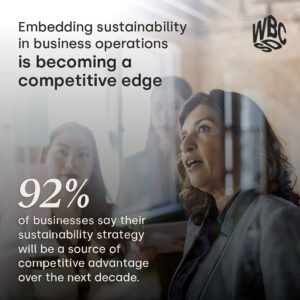 As concerns over a disorderly climate transition grow, business leaders are not retreating — they continue to back sustainability. A striking 92% expect it to be a source of competitive advantage over the next five to ten years, with a vast majority (89%) maintaining or increasing investment. According to the report, businesses are scaling investment in measures such as clean power, electrification, circularity and regenerative agriculture because these are the most cost competitive, secure and resilient options available. Falling technology costs, exposure to fossil fuel price volatility, climate impacts and rising supply chain risks are shifting the economics decisively in their favor.
Economic risks of inaction
The report’s insights are intended to inform and support government decision-making. Nearly all businesses (96%) now factor climate transition dynamics into their investment decisions, with policy clarity and stability emerging as the most important factor (56%), alongside access to enabling infrastructure and affordable clean energy.
At the same time, the findings highlight the economic risks of insufficient or uncoordinated action. Without strengthened policy and delivery, nearly a quarter (22%) warn that the most significant consequence of a disorderly transition would be inflation and higher prices for consumers.
The message from business leaders is clear: without stronger, predictable, coordinated policy, the risk of a more costly and disorderly climate transition will continue to rise. Businesses are remaining steadfast in their sustainability efforts, not in spite of this risk, but because they see it as essential to managing and avoiding it.
About the report and FIBS’ involvement
The Business Breakthrough Barometer is WBCSD’s flagship report, developed in partnership with the Breakthrough Agenda, the Marrakech Partnership and with the support from Bain & Company and the Climate High-level Champions. The report is based on survey responses from more than 500 senior business leaders across 50 economies and on every continent, complemented by 70 in-depth executive interviews and sectoral business convenings spanning all regions of the world.
Finnish companies have contributed to the global Barometer through a survey distributed by FIBS. FIBS has been a member of WBCSD’s Global Network since 2012.
FIBS will publish a separate Finland-specific report on 25 August, drawing from the global Business Breakthrough Barometer. You can register for the launch webinar here.