
The Science Based Targets initiative (SBTi) Corporate Net-Zero Standard Version 2.0 (CNZS V2.0) updates target-setting, progress tracking, and value chain reporting. Drawing from insights shared during FIBS’ webinar hosted by South Pole, this guide answers key practical questions sustainability professionals face when preparing to align with the new standard.
Can a 2025 inventory serve as a baseline for targets set in mid-2027?
Yes. CNZS V2.0 requires companies to select the most recent year with complete data as the target base year—defined as no earlier than two years prior to submission. For a 2027 submission, both 2025 and 2026 baselines meet the compliance criteria.
Will near-term targets remain untouched during mandatory 5-year reviews?
All active near-term and long-term targets must be reviewed at least every 5 years from their date of initial validation to ensure alignment with the latest criteria. Companies undergoing their 5-year review in 2028 or later must update both near-term and net-zero targets to Version 2.0 simultaneously, ensuring methodological alignment across target baselines, boundary coverage, and accounting rules.
How does V2.0 accommodate rapid M&A growth?
V2.0 includes some ways to handle structural changes as companies grow:
- Dynamic Base Years: Companies establish a new target base year at the start of each 5-year cycle, integrating acquired operations into the baseline.
- Like-for-Like Recalculations: Mid-cycle structural changes altering emissions by 5% or more trigger a mandatory retroactive baseline recalculation and updating targets if the new baseline results in current targets not meeting all criteria anymore (e.g. if a certain scope 3 category was below the 5% threshold, now is above the 5% threshold).
- Alignment Targets: SBTi V2.0 introduces target-setting methods focused on alignment (e.g. purchasing a higher share of low-carbon goods). This allows growing companies to meet targets without requiring immediate absolute emission cuts in the short term. It should be noted that these methods do not exempt companies from carbon accounting or overall 1.5°C climate goals and companies must still calculate, report, and audit their complete physical GHG inventory in absolute metric tons CO2e every year and at the end of the 5-year cycle their objective is to introduce flexibility on the pathway there
What are the annual tracking and assurance requirements?
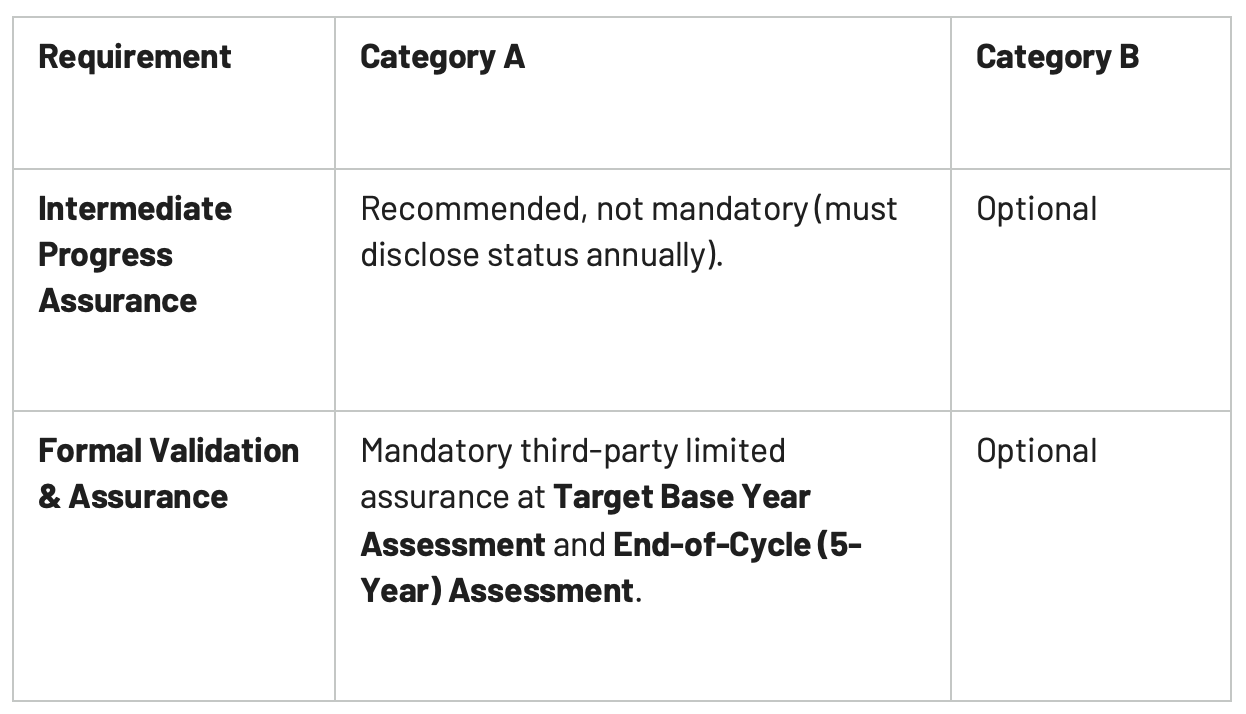
Base years and target years require independent 3rd party assurance. In addition, companies must report progress annually in free, publicly accessible locations (e.g., website, sustainability report, CDP).
What is an “operational asset transition target” in Scope 1?
For capital-intensive assets, an Asset transition target serves as an alternative to linear absolute contraction. It establishes a concrete timeline to retire, retrofit, or phase out fossil-fuel equipment. For example, committing to stop natural gas furnace investments by 2028, decommissioning 50% by 2032, and fully electrifying by 2035 within a defined carbon budget. Setting this target requires publishing a board-approved Climate Transition Plan (CTP) at the time of target validation. Note that when using the asset transition target setting option, it’s mandatory to also set a long-term scope 1 target.
Does V2.0 reduce reliance on primary, supplier-specific Scope 3 data?
Yes. Companies can use near-term Scope 3 target options that reduce reliance on supplier surveys. Alongside the Supplier Alignment Target method (tracking the spend or the share of Tier 1 suppliers with validated targets), companies can set Volume Alignment Targets to increase purchases of lower-carbon goods or freight services.
While primary supplier data remains essential for GHG Protocol accounting, secondary data, EEIO spend models, and proxies are permitted for baseline estimation, enabling immediate physical engagement.
What evidence is required to exempt a company from setting a FLAG target?
Companies outside designated FLAG sectors are exempt only if gross land-related emissions represent less than 20% of total emissions. This must be demonstrated through mandatory quantification of gross land use change (LUC) and land management emissions under the GHG Protocol Land Sector and Removals Standard (LSRS).
What are the requirements for FLAG and Forest Product sectors?
FLAG targets are mandatory now under the SBTi FLAG Guidance V1.2. Forest and paper companies (or those where wood fiber accounts for 10% of FLAG emissions) must use the timber & wood fiber commodity pathway.
Are there provisions for AI and digital infrastructure?
While V2.0 lacks a dedicated ”AI sector methodology,” it enforces specific operational accounting rules:
- Scope 2 Hourly Matching: Category A companies consuming 10 GWh/year in electricity activity pools (e.g., data centers, cloud infrastructure) must calculate and report the percentage of Scope 2 electricity consumption matched with low-carbon electricity (LCE) on an hourly basis.
- Large growth in electricity consumption: Companies that have more than 20% yearly growth in electricity consumption are not eligible for LCE target setting in scope 2 and must set absolute reduction targets for scope 2 (an additional LCE target is optional).
- Scope 3 IT Hardware: Digital businesses must capture embodied carbon in servers and chips under Scope 3 Categories 1 (Purchased Goods) and 2 (Capital Goods), as well as electricity consumption under Category 11 (Use of Sold Products).
How do OER, Carbon Credits, and Neutralization differ under V2.0?
CNZS V2.0 distinguishes between intermediate obligations during the transition and final net-zero claims:
- Ongoing Emissions Responsibility (OER) (Pre-2035): Voluntary participation across three recognition tiers (Engaged, Advanced, Leadership). Under Leadership, Category A companies set an annual Contribution Budget ( $80 per tCO2e) with which they fund verified mitigation outcomes (e.g. carbon credits meeting high standards regarding additionality, traceability, measurability, and permanence) equal to their total footprint. Any remaining budget can be then used to support verified mitigation and/or other eligible climate actions.
- Mandatory Post-2035 OER (Criterion CNZS-C45): Starting in 2035, Category A companies face a mandatory requirement to fund eligible carbon removals equal to at least 1% of ongoing emissions in 2035, scaling linearly to 100% by their net-zero target year. At least 10% must come from long-lived, durable storage starting in 2035, scaling to 100% at net-zero.
- Neutralization: Applies strictly at the net-zero target year (2050 or earlier) after achieving deep decarbonization (90% absolute reduction). Requires counterbalancing 100% of residual emissions using permanent carbon dioxide removals (CDR) such as DACCS or BECCS.
Is post-2035 OER calculated from baseline or actual emissions?
It is derived strictly from actual ongoing emissions produced in that specific reporting year (CNZS-C45.1). Every ton abated directly lowers the required volume—and cost—of mandatory carbon removals. To address cost concerns, pre-2035 OER remains voluntary, and the SBTi will formally review the 2035 requirement in Version 3 to align with carbon market pricing and removal availability.
How should we approach the standard as an organisation
To leverage the CNZS V2.0 updates for corporate resilience and commercial advantage, organizations should prioritize the following next steps:
- Review company classification and benchmark: Confirm whether your organization falls under Category A or B to understand mandatory assurance and reporting obligations. Compare current targets against V2.0 requirements.
- Governance & board ownership: Secure formal Board-level sign-off and establish clear governance pathways for target implementation and delivery accountability.
- Adjust Procurement Approaches: Review supply chain strategies to use V2.0 Scope 3 target flexibilities, prioritizing key supplier categories.
- Market Instrument Compliance: Align your EAC procurement, biomethane tracking, and carbon credit portfolios with the new age limits, deliverability rules, and OER requirements.
Your Transition Roadmap: Turn Climate Targets into Real Action
If your targets are already validated under V1.3.1, you are on the right path—they remain fully valid for their 5-year cycle! While formal revalidation under V2.0 won’t be required until your 5-year review (or following a major structural shift like an M&A over 5%), waiting until the deadline means missing out on opportunities.
Aligning with V2.0 provides a clear structure to coordinate sustainability, finance, and operational teams. Reviewing your emissions data early helps prepare your organization for upcoming reporting cycles and target updates.
Authors & more information

Marie Gustafsson
Principal Consultant, South Pole
m.gustafsson@southpole.com

Bence Cserna
Associate Director, South Pole
b.cserna@southpole.com

Jenny Wickstrom
Sales Manager Nordics, South Pole
j.wickstrom@southpole.com

South Pole is a climate partner of FIBS.